Live-Action + 3D Animation: How to Explain Technology Gamers Have Never Seen | Ludeo
When the product is a completely new concept — not an improvement on something existing — the film must do two things simultaneously: make the gamer feel the wow and make the investor understand the how. An analysis of the solution at Ludeo.
The Problem: Convincing Someone They Want Something They've Never Heard Of
When the product is an improvement on something existing — it's relatively easy to talk about. "Faster, cheaper, simpler." The viewer understands the foundation.
But when the product is a completely new concept — the film must first create the need, and only then present the solution.
Ludeo built technology that lets a gamer take a YouTube clip of another player, enter directly at the precise moment the epic moment happened — and play it themselves. Compete. Win. Share.
A concept like this doesn't exist in the current language of gaming. The film needed to be the tutorial for the experience.
Two Audiences, One Film
Ludeo's brief came with a unique challenge: the film needs to work for two completely different audiences.
Audience A — The Gamer: Wants to feel. Not understand. If you explain too much — you've lost them. They need to see the wow and think "wait — can I do this?!"
Audience B — The Investor/Game Developer: Wants to understand. Not just feel. They ask: how does the technology work? What does this mean for monetization? How does it integrate with existing platforms?
The solution we found: parallel narrative layers.
The Visual Solution: Two Worlds, One Conversation
We built a dual-layer narrative structure:
Layer 1 — Realistic Live-Action
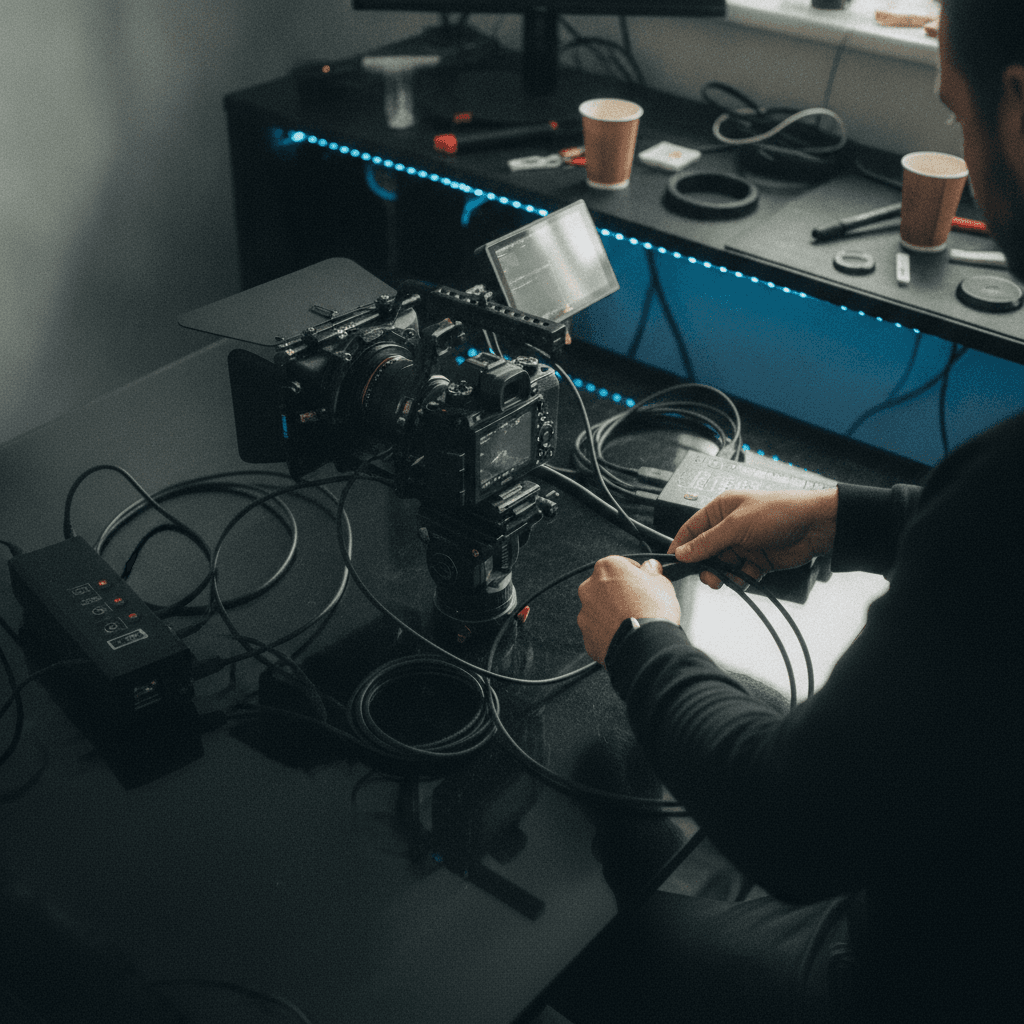
A real gaming room. A real gamer. Screens, purple-blue RGB lighting, night atmosphere. All familiar, all authentic. This is the language the gamer speaks.
In this layer, the film begins with frustration — a gamer watching gameplay videos from the sidelines, knowing they can beat the record, but unable to enter. And then — Ludeo arrives.
Layer 2 — Futuristic 3D Animation
What happens "behind the scenes" — in the "Ludeo Lab" — is presented as an abstract 3D world: abstract blue figures managing the technology. They clip epic moments. Define objectives. Create a single-player shareable file.
Why this separation? Because animation has the ability to translate a technical process into direct visual without disrupting the narrative flow. The gamer continues seeing a "story" — the investor understands the "what."
Building the VFX: Make Technology Look Seamless
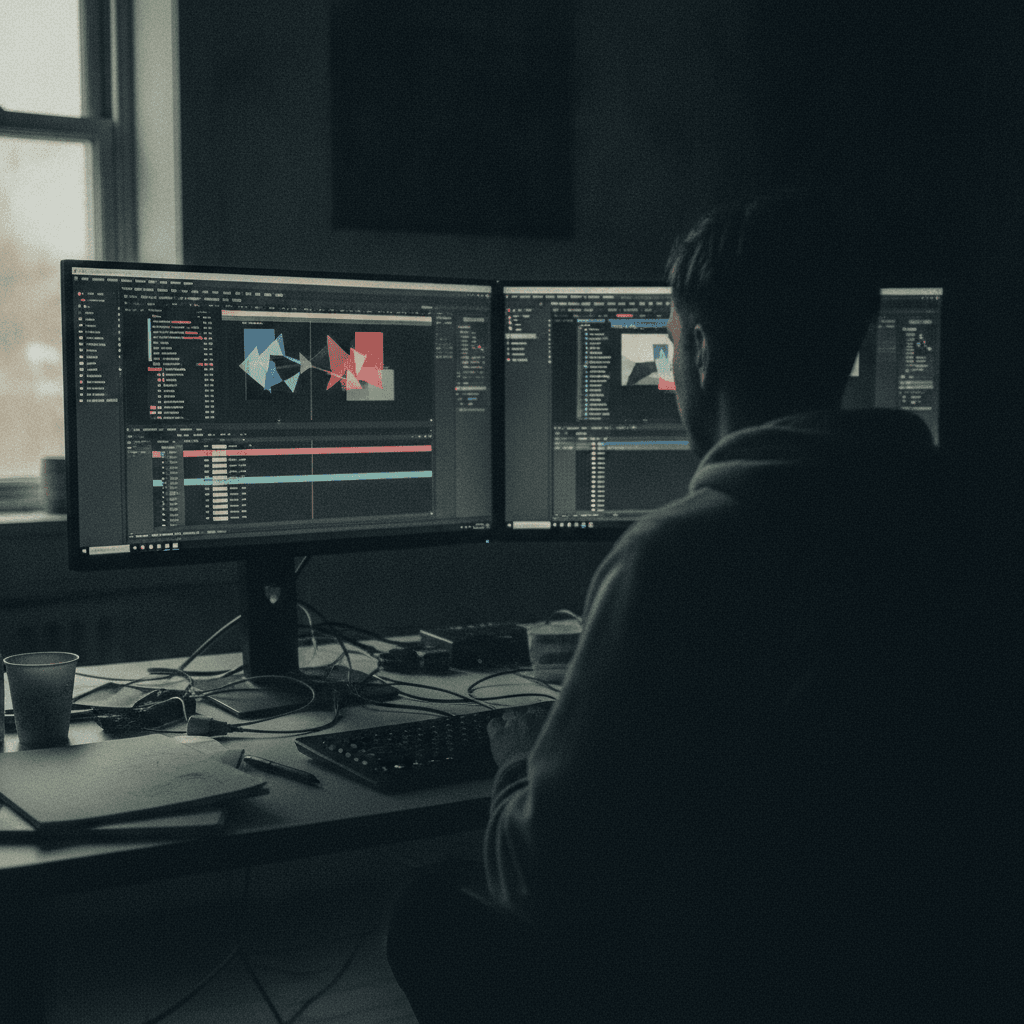
The most complex technical-creative phase: UI/UX Integration — making the user interface appear as an integral part of the scene, not a generic overlay.
The rule that guided us: The UI is a character in the scene — not a caption.
The Leaderboard isn't shown as a screenshot. It appears and responds to the gamer's actions in real-time — rises, marks victory, enables sharing.
The epic moment selection interface isn't explained — it's shown: the gamer clicks, the world is sucked in.
The Direction: Gaming Energy, Not a Presentation
Gamers develop sharp radar for fake content. When a gaming company produces content that looks like a marketing presentation — they leave within seconds.
Ludeo's direction was built on a pace that directly mirrors gaming energy itself: fast, visceral, with clear payoffs.
Setup: Frustration → Discovery → The Turning Point → Victory → Sharing.
Every step feels like progression in the game itself. The viewer doesn't watch a film — they live the gameplay loop.
What This Means for Tech Companies Explaining New Concepts
What we learned from Ludeo: When the product is real innovation — you can't rely on the product to speak for itself. The film must create the mental model before it presents the product.
Three steps that work: 1. Create the pain — show what exists now and why it's not enough 2. Show the solution — visual, tangible, fast 3. Let the viewer imagine themselves there — not "the product does X" but "you can do X"
That's the difference between a film that explains and a film that sells.
videoshop
Boutique Video & AI Production Studio
Related Service
High-Tech & Startup Video ›Continue Reading
videoshop
Your next project starts with a conversation
We don't work with everyone. We work with those who want to make something worth remembering. If that sounds like you, let's talk.
Let's Talk