3,000 Employees, 6 Scenes, One Map: What Producing Intel IDC Haifa's Emergency Drill Teaches You
When you have six simultaneous emergency scenes — Hazmat, height rescue, acid leak, crash site, building sweeps, and command center — the challenge isn't filming. The challenge is making the viewer understand what's happening. The solution: a map.
The Problem of 6 Simultaneous Fronts
An emergency drill involving 3,000 employees at Intel IDC Haifa is not an event you film from one spot.
This is a vast campus with six active zones simultaneously: acid leak, height rescue (USAR), Hazmat incident, debris search, mass building evacuation, and an external command center managing everything.
The narrative problem: you can film all six zones separately and get six impressive video clips. But in the end you get a film where the viewer has no idea where they are.
The real challenge wasn't logistical — it was narrative.
The Solution: The Map That Connects Everything
The most impressive element of IDC's post-production is the dynamic HUD map.
We took an aerial photograph of the campus and the graphics team built a three-dimensional HUD (Heads-Up Display) layer over it — exactly like what you see in tech and action films. Each scene is marked, numbered, and displayed on top of the real campus.
What this does for the viewer: - They always know "where they are" within the campus - Transitions between zones feel like moving between phases of an operation — not random cuts - A sense of management and control transfers to the viewer: "This company knows what it's doing"
Real-Time Filming: Six Teams, Six Briefings
Before shoot day, we prepared a detailed coverage map:
- Zone 1 — Acid Leak: Hazmat team with specialized sealed suits. One shoulder-rig camera following close.
- Zone 2 — Height Rescue (USAR): Fire department crane for high-floor rescue from a balcony. Drone + ground camera.
- Zone 3 — General Hazmat: Organized evacuation, protective gear deployment. Close-ups on hands, faces.
- Zone 4 — Crash Site: Casualty extraction from simulated concrete debris. Dynamic shoulder rig.
- Zone 5 — Building Sweeps: ERT scanning floors and shelters building by building. Drone + shoulder.
- Zone 6 — Command Center (HQ): Drone surveys overall deployment, then enters interior for command team coverage.
Every cinematographer received a radio, a printed map, and a 20-minute briefing.
Why Aerial Shots Change Everything
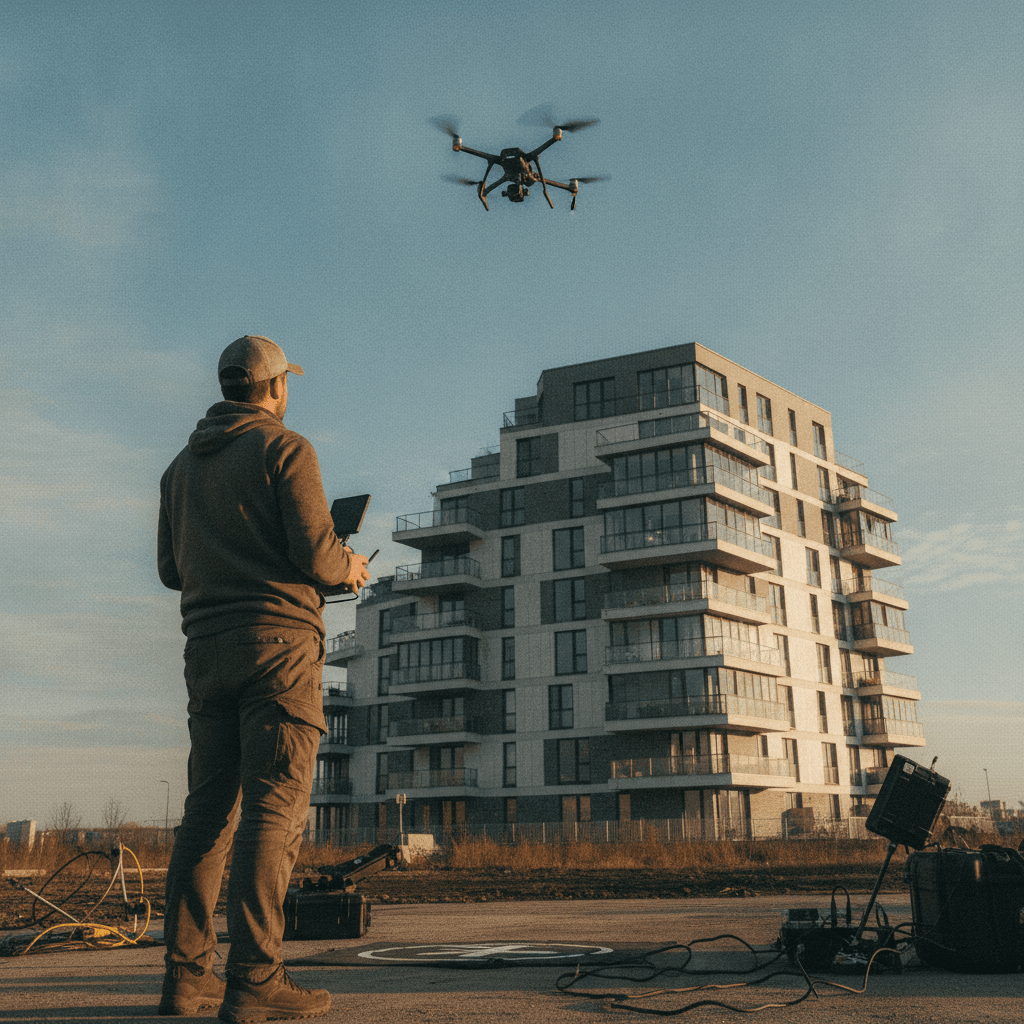
In emergency drill films, the drone doesn't just "shoot from above." It solves a narrative problem.
When the camera rises and shows 3,000 people evacuating campus facilities — scale is transferred to the viewer. They understand this isn't a 50-person drill. This is a complete mechanism functioning in real time.
Combined with the graphics, the aerial shots became bridges between zones — every time we move to a new scene, a drone rises, the map shows the location, and we dive in.
The result: a film that looks like an operation documentary — not a safety conference.
The Three Layers of Business Impact
When a client asks "why should I film my emergency drill?" the answer has three layers:
Layer 1 — Actual Training: 90% of executives won't read a 60-page safety manual. They will happily watch a 4-minute film that shows them how an ERT team actually operates, not in theory.
Layer 2 — Regulators and Partners: Intel operates in Israel and globally. When there's a safety inspection from OSHA or a European regulator, a film like this proves actual performance — not statements of intent.
Layer 3 — Employer Branding: Engineers looking to work at Intel see the film. They don't just see "a tech company." They see an organization that invests at a level of preparedness other companies don't reach.
This is not a safety asset. This is a recruitment asset.
What IDC Haifa Teaches for Your Project
If you have an organizational event that happens once — a drill, a conference, a field day, an evacuation — it's worth filming.
The critical point: orchestration comes before filming. At IDC, we invested more time in planning than in actual filming. Who stands where, who covers what, what happens if two zones heat up simultaneously.
Because in a shoot like this, there's no "cut."
videoshop
Boutique Video & AI Production Studio
Related Service
High-Tech & Startup Video ›Continue Reading

videoshop
Your next project starts with a conversation
We don't work with everyone. We work with those who want to make something worth remembering. If that sounds like you, let's talk.
Let's Talk